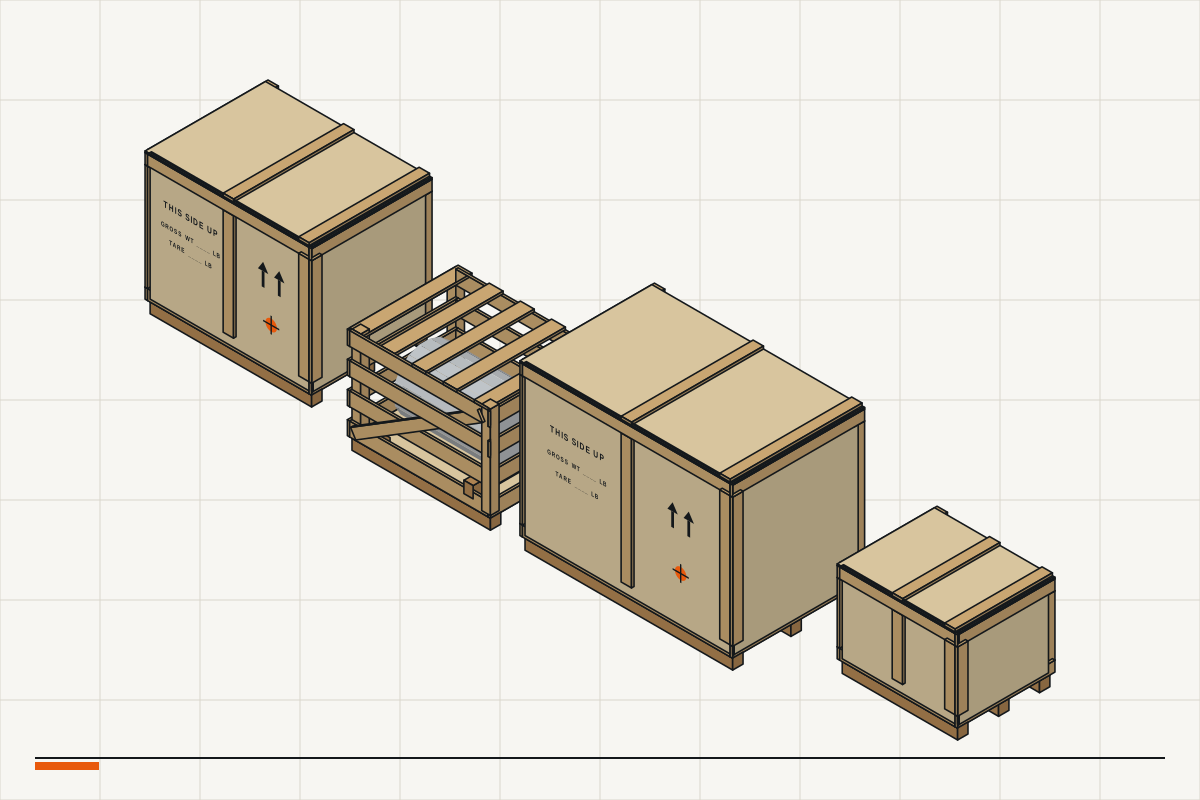
Crate spec ticket
| Measuring and buying | Measuring, cost, skid vs crate |
|---|---|
| Packing and protection | Build, markings, indicators, rust, desiccant |
| Freight | Freight class, crate tare and cube |
| Export rules | ISPM 15, HT, used crates, stamps |
| Quote needs | Inside dimensions, gross weight, country |
| Written spec | Kept on file for repeat orders |
Guides: every page
How to use these guides
A crate order goes wrong in a small number of predictable places: a load measured with the wrong tape, a gross weight guessed from a brochure, a bag of desiccant bought without a barrier bag to hold it, a stamp that does not match the lumber. The guides below are organised around those moments rather than around crate products, so you can open the one that matches the problem on your desk today.
Each guide is written the way an estimator talks while walking a dock with a clipboard. It names the parts of the crate, asks for the number before it describes the adjective, and says plainly when a figure belongs to the builder, the forwarder or the destination authority and not to us. Where a guide leans on a rule, it points to the body that publishes the rule.
Measuring and buying
Every quote starts from the load's inside dimensions, its gross weight and the destination country. The first three guides get you from a machine on the floor to a crate you can price and compare.
Measuring comes first because everything else, from cube to freight class to the size of the skid, follows from it. Buying comes next: what moves the freight bill, and whether the load needs walls at all.
- How to measure a load for a shipping crate (/guides/how-to-measure-for-a-crate): inside dimensions, clearance for blocking, gross weight, centre of gravity and lift points.
- What a crated shipment costs to move (/guides/crate-shipping-cost): dimensional weight, cube, accessorials and how to keep each one down.
- Skid, crate or pallet (/guides/skid-vs-crate-vs-pallet): what each carries, and when a load needs walls and a lid.
Packing and protection
A crate that holds its shape but lets the load slide, rust or arrive tipped over has failed in a different way. These guides cover the working parts inside and on the outside of the crate.
Read the build guide if you want to understand a quote line by line. Read the marking and indicator guides before the crate is closed, since stencils and labels are far easier to fix on a bench than on a dock. Read the rust and desiccant guides together, because a desiccant pack with no sealed bag around it does very little.
- How a wooden shipping crate is built (/guides/how-to-build-a-shipping-crate): skid, runners, floor, walls, cleats, top and fasteners.
- What goes on the side of a shipping crate (/guides/crate-markings): weight in lb and kg, centre-of-gravity mark, handling pictograms and the consignee panel.
- Tip and impact indicators on crates (/guides/tip-and-impact-indicators): where to fix them and what a tripped label tells a receiver.
- Stopping rust in an export crate (/guides/rust-prevention-vci): VCI film and paper, barrier bags and heat sealing.
- How much desiccant a crate needs (/guides/desiccant-sizing): what decides the unit count and why the bag matters.
- How machinery is crated for shipping (/guides/crating-machinery): draining, bolt-down, bracing and skid sizing for truck, sea and air.
Freight
Once a load is crated it is a different piece of freight. It is bigger, heavier and usually less dense than the bare machine, and the carrier prices what is on the bill of lading, not what you had in mind.
The freight class guide explains why density drives class for many commodities under the NMFC, how crate tare and cube move that density, and what to print on the paperwork so the carrier's inspection agrees with it. We do not assert class numbers for crates there, because the classification is the carrier's and the NMFC's call for the commodity and packaging as shipped.
- Freight class for wooden crates (/guides/freight-class-for-crates): NMFC, density, and the crated dimensions and weight that belong on the bill of lading.
Export rules
Wood packaging that crosses a border is regulated apart from the goods inside it. The international standard is ISPM 15, administered in the United States through USDA APHIS and, for the heat treatment program, the American Lumber Standard Committee. Lumber crates, skids and runners need an approved treatment and an official mark, and plywood and other processed panels are exempt from the treatment requirement.
These guides take the rule apart in pieces: what the standard asks, what heat treatment actually means, how to read the stamp, what the plywood exemption leaves out, and why a used crate is a bigger question than it looks. None of them states which countries require ISPM 15. That list changes, and the destination country's plant-protection authority and APHIS are the places to confirm it for your shipment.
- ISPM 15 requirements for wood crates (/guides/ispm-15-requirements): approved treatments, debarking, the official mark and the exemptions.
- What heat-treated wood means on a crate (/guides/heat-treated-wood): the 56 °C core temperature for 30 minutes, verification, and how HT differs from kiln drying.
- Can a used crate ship export (/guides/used-crates-for-export): re-marking rules for replaced boards and when a new crate is the safer purchase.
- How to read an ISPM 15 stamp (/export/ispm-15-stamp): the symbol, country code, producer number, treatment code and agency mark, part by part.
- The ISPM 15 plywood exemption (/export/plywood-exemption): what is exempt, and the lumber members of a plywood crate that are not.
Which guide first
If you have a load and no crate, start with the measuring guide and write down the three numbers we ask for on every quote: inside dimensions in inches, gross weight in pounds, and the destination country. If you already have a quote and want to understand it, the build guide and the skid-versus-crate guide explain the line items.
If the load is going overseas, read the ISPM 15 requirements guide before anything about design. The treatment and the stamp are not decoration, and a crate that fails inspection at the destination can cost more than the crate itself. If you ship the same machine every quarter, tell us at the quote stage, since we write the crate spec down and keep it on file so a repeat order is built the same way.
Where the guides stop
Hazardous materials are governed by 49 CFR and, for air, by IATA rules, and a guide on a crating site is not the place to classify a battery or a pressurised cylinder. Military packaging is covered by MIL-STD-2073, and if your contract cites it, send us the contract clause. Open and covered wood crates are described in ASTM D6039, and wood-cleated panelboard boxes in ASTM D6251, which are useful references if a purchase order names either.
Where a guide cannot give a number, it says why. Clearance around a load, the count of desiccant units and the freight class for a given crate are set by the builder, the packer and the carrier from the facts of your shipment. Send those facts through the quote form below and the answer comes back as a written crate spec.
Questions buyers ask
Which guide should a first-time crate buyer read?
Start with how to measure a load for a shipping crate. It lists the numbers every quote needs and explains why we ask for the load's inside dimensions and not the size of the pallet it sits on.
Do the guides give crate prices?
No. Price depends on the load's dimensions, weight, wood and export treatment, so the cost guide explains what moves the bill and the quote form turns your numbers into a price.
Where do I confirm whether my destination requires ISPM 15?
Ask USDA APHIS and the destination country's plant-protection authority. We build to the standard, but the import requirement belongs to the receiving country.
Can I send a drawing instead of measuring the load myself?
Yes, a dimensioned drawing or the manufacturer's shipping data sheet works as a starting point. We still ask for the gross weight as it will actually ship, with any bolted-on options.