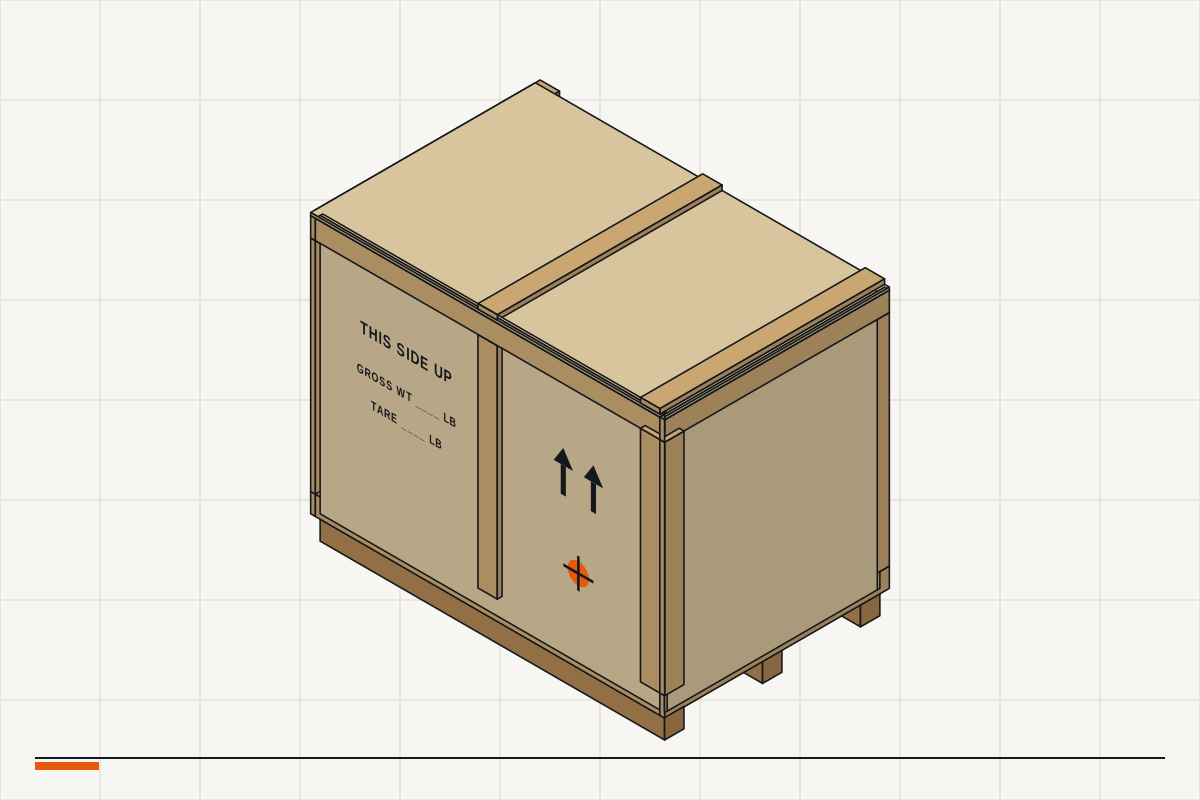
Crate spec ticket
| Inside dimensions | Length x width x height of the load in inches, including any overhang |
|---|---|
| Gross weight | Pounds, with the weight of any pallet or fixture it sits on |
| Centre of gravity | Where the load balances, or a note that it is off-centre |
| Handling | Fork pockets, crane lifting points, or both |
| Interior | Blocking and bracing, VCI film, desiccant bags, tip indicator |
| Marks | Handling pictograms, centre-of-gravity mark, IPPC stamp if export |
| Destination | Country and mode: sea, air or truck |
What a custom wooden crate is
A custom crate is not a catalogue item with a different label. Nobody picks it off a shelf. We start with the load and work outward: the footprint it needs on the skid, the height it needs under the lid, the clearance it wants for blocking, and the wall construction that suits the journey.
The result is a crate whose members have a reason to be there. A runner sits under the heaviest line of the load. A cleat backs each plywood joint. A strongback crosses the top where a long span could flex. If a member does nothing, it is not in the drawing.
Custom crates are priced from that drawing, which is why the quote needs numbers before it needs adjectives.
What we need to quote a custom crate
Three figures open every quote: the load's inside dimensions as length x width x height in inches, its gross weight in pounds, and the destination country. Add the quantity and the date you need the crate at your dock, and we can price it.
Photographs help a great deal, especially of the underside of a machine, its mounting feet and any projecting handles, gauges or pipework. Tell us if the load has a tare weight you can separate out, such as a pallet that stays behind.
If you have not measured yet, our measuring guide walks through it. Measure the load as it will sit in the crate, with doors closed and handles in the stowed position, and write the figures in inches.
How a custom crate is built, member by member
The base is a skid: two or more timbers that lift the crate for forks and carry the load's weight. Runners or cross-members tie the skids together and spread the load. For heavy equipment the load bolts to the base with lag bolts, so it cannot shift even if the crate is dropped or tipped.
The walls are either open or closed. Open slatted walls save weight and let you see the load. Closed sheathing, in plywood or boards, protects against weather and handling damage and can take a liner. Cleats frame each panel and give the fasteners something solid to bite.
The lid is the last piece and the first piece your receiver opens. We detail how it comes off so the crate can be opened without cutting into the contents.
- Skid and runners sized to gross weight
- Walls matched to weather and handling exposure
- Cleats at every panel joint
- Lid, with notes on how it opens
- Blocking and bracing cut to the load's frame
Choosing the wall construction
The wall decides what the crate does for the load. The constructions hub draws all ten. For custom work the usual candidates are slatted, sheathed plywood, cleated plywood, skid-base and solid lumber.
A slatted crate suits parts that can take air and a little weather. A sheathed plywood crate closes the load in, which matters for sea freight and for anything that rusts. A skid-base crate, a base with a top frame and no walls, suits large equipment on a short trip. Solid lumber is for the heaviest, roughest cases.
| Construction | Reach for it when |
|---|---|
| Slatted | Air flow matters and weather exposure is low |
| Sheathed plywood | The load must be sealed in or lined |
| Cleated plywood | The load is light to medium and the box should be flat-faced |
| Skid-base | The load is large, heavy and robust |
| Solid lumber | Gross weight is high and handling will be rough |
Interior packing: blocking, VCI, desiccant and indicators
A crate that holds the load still is half the job. The other half is what happens inside it over weeks in a container. Blocking and bracing stops movement in each axis. VCI film or paper protects bare steel from corrosion. Desiccant bags take up moisture in a sealed crate. Tip and shock indicators tell the receiver whether the crate was mishandled.
These items are listed on the spec so they are priced, not discovered. If your load has bare ground surfaces, say so on the request. If it is going by sea, say so as well.
Marks, stamps and paperwork on the outside
We mark crates with ISO 780 handling pictograms where they apply, a centre-of-gravity mark where the load is not centred, and the shipper's reference. Export crates made with solid wood carry an IPPC stamp showing the ISPM 15 treatment, applied by the facility that treated the lumber.
Plywood is exempt from the treatment rule, so a fully plywood-sheathed crate on a skid built of treated lumber still needs the skid stamped. Destination rules differ, so check the country's plant-protection authority as well as APHIS.
Repeat orders and the spec on file
We keep the written spec for each custom crate. When you reorder, the crate ships the same way: same members, same fasteners, same marks. That matters when a receiving plant has learned how to open yours, or when a customs broker has your crate on file.
If the load changes, tell us. A heavier motor or a taller frame is a new gross weight and a new set of inside dimensions, and the spec is revised, not stretched.
Questions buyers ask
How do I get a custom crate quote?
Send the load's inside dimensions in inches, its gross weight in pounds and the destination country, plus quantity and the date you need it. Photographs of the underside help.
Can you build a custom crate for export?
Yes. Export crates use treated lumber with the IPPC stamp, or plywood where the exemption applies. Check the destination country's plant-protection rules and tell us the country.
What if my load's weight is only approximate?
Give us the nameplate or catalogue weight and say it is approximate. The skid is sized to gross weight, so a scale ticket before the final order is worth having.
Can you add VCI and desiccant to a custom crate?
Yes. We list VCI film, desiccant bags and indicators on the spec so they appear in the price.