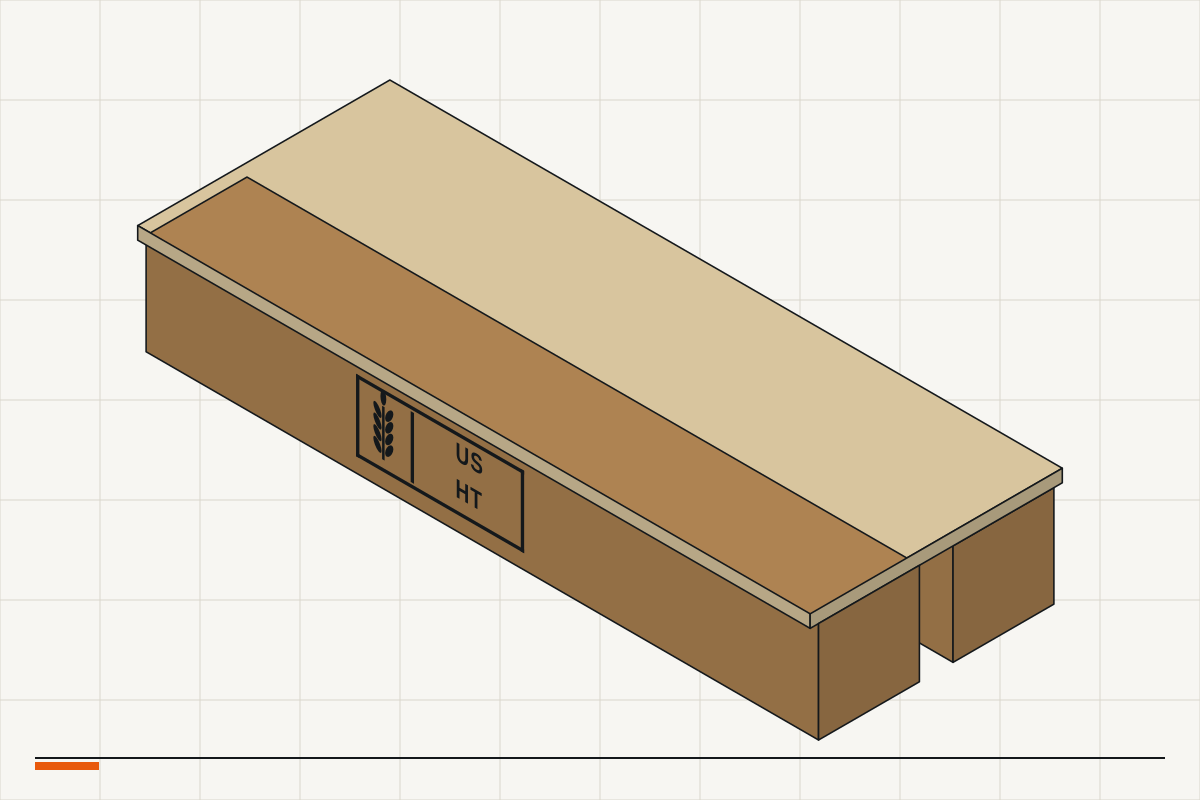
Crate spec ticket
ISPM 15 · HT| Lumber | HT-marked softwood boards and timbers |
|---|---|
| Marked members | Skid, runners, cleats, frame, lid rails |
| Panels | Plywood or OSB, not part of the HT chain |
| Repairs | New boards carry their own HT mark |
| Records | Spec and lumber source kept on file |
| Ask for | Gross weight, inside dimensions, destination, quantity |
What the HT code actually certifies
HT stands for heat treatment. On a stamp, it is the treatment code, the letters that tell an inspector which of the approved methods was used on that piece of wood. It does not describe moisture content, grade or strength. It says the wood went through the heat schedule and the producer is accountable for it.
USDA APHIS sets that schedule at a minimum wood core temperature of 56 degrees C for at least 30 minutes. The word that matters is core. Surface heat does not count, because the pests of concern live in the middle of the board. Treatment plants measure the temperature inside the stack, not in the room.
The program is supervised. APHIS says the ALSC administers the US heat treatment and methyl bromide programs, and that heat-treated packaging must carry the official ISPM 15 mark with the quality mark of an ALSC accredited agency. A mark without that agency behind it is not a valid mark.
Buyers rarely see the treatment plant or its records, which is exactly why the printed mark has to be readable evidence by itself, backed by the agency named beside it.
Heat-treated is not the same as kiln-dried
Buyers mix these two up all the time. Kiln drying takes moisture out of lumber to reduce shrinkage, mould and warp. Heat treatment under ISPM 15 raises the core temperature to a set point for a set time to kill pests. A kiln can be run to do both, but kiln drying alone is not the ISPM 15 treatment.
To count, the kiln run must meet the heat-treatment schedule and the lumber must be marked HT by an agency-supervised producer. A board that was kiln-dried and left unstamped is still an unmarked board in the eyes of a port inspector, however dry it is.
If a supplier tells you their lumber is kiln-dried and so it is fine for export, ask for the HT mark. If there is none, the lumber is not export-ready.
How we build with HT stock
We start from HT-marked boards and timbers and size each member for the load: the skid and runners from gross weight, the cleats from the sheathing and the stacking, the lid frame from what will sit on it. Where a member has to be cut, we cut it so a stamped face stays on the finished piece.
The finished crate is then marked. NELMA states finished crates and skids carry the facility's IPPC stamp on a minimum of two opposite sides. Those two marks are what the destination inspector will look for first, so we place them on faces that handling will not cover or crush.
We write down which lumber source went into the order and keep that note with the crate spec. If you reorder, the crate is built the same way.
Timber for heavy crates arrives in larger sections, such as four-by-four runners and six-by-six skid beams, and big timbers take longer to reach core temperature than thin boards. That is a reason to buy marked stock from the treatment yard and not to treat timbers in house. Nobody should guess whether a thick beam reached the required heat.
Remanufactured, repaired and rebuilt crates
A crate that has been cut down, rebuilt or repaired is a remanufactured crate under the program. NELMA says a remanufacturer must re-stamp each component with its own agency-issued HT stamp. The original mark on a surviving board does not carry over to a newly added one.
That is why a repaired crate can be perfectly sound and still not be export-compliant. If three boards were replaced, those three boards need their own HT mark, and the repair must be done under a program that can stamp them.
We do not promise a treatment mark on a used crate before we have seen the lumber. Send the crate details with your quote request and we will say which members can stay and which need to be replaced with HT stock.
Pressure-treated and painted lumber
Pressure-treated wood is a common source of confusion. NELMA says it meets ISPM 15 only if it was heat-treated and stamped HT before the preservative treatment. If the HT mark is missing, the preservative does not stand in for it.
Paint and sealer are separate questions. A crate that will be painted or sealed for sea freight should have the stamp left clear. A mark painted over cannot be read and may be refused.
Questions to ask any lumber supplier
Which accredited agency inspects your plant? What is your producer number? Is every board marked, or only the bundle tag? Can you show the treatment record for this lot? A supplier who stamps only bundle tags is of no use to a crate builder, because the stamp has to survive cutting and be on the finished piece.
Also ask about storage. Treated lumber left outside for months, rained on and stacked on dirt, collects mould, and some inspectors look askance at it. We stack stock under cover and rotate it.
Finally, ask how they handle returned or rejected lots. A traceable chain from kiln to crate is what the HT mark is supposed to represent.
Questions buyers ask
What does HT mean on a crate?
HT is the treatment code for heat treatment. It tells an inspector the lumber was heated to a required core temperature for the required time under an accredited program.
Is kiln-dried lumber the same as heat-treated lumber?
No. Kiln drying alone is not the ISPM 15 treatment. It counts only if the run meets the HT schedule and the lumber is marked.
Can a repaired crate keep its original stamp?
Not for the replaced parts. New boards need their own HT mark, and a remanufacturer must re-stamp each component.
Do plywood panels need an HT mark?
No. Plywood, OSB and other processed panels are exempt, but the lumber skid, runners and cleats are not.