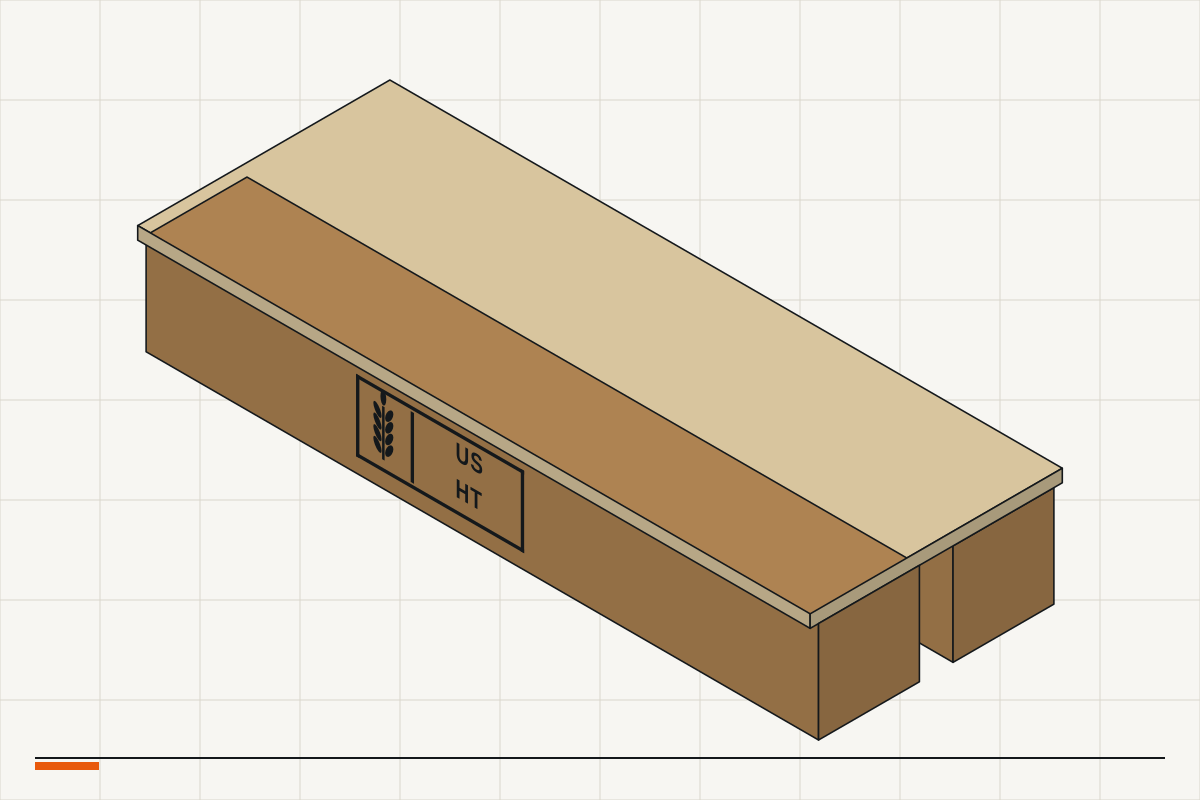
Crate spec ticket
ISPM 15 · HT| Lumber | HT-marked softwood for skids, runners and cleats |
|---|---|
| Panels | Plywood or OSB sheathing, exempt from ISPM 15 |
| Marking | IPPC stamp on two opposite sides; handling marks |
| Moisture | Barrier bag, VCI film, desiccant for sea lanes |
| Paperwork | Packing list kept with the crate spec |
| Ask for | Inside dimensions, gross weight, destination country |
Export: every page
| Page | What it is for | Quote |
|---|---|---|
| ISPM 15 crates | Treatment: HT, the heat code on most crates | Quote this |
| Heat-treated crates | Code: HT on the stamp | Quote this |
| Seaworthy crates for ocean freight | Walls: Sheathed plywood on a cleated frame | Quote this |
| Air freight crates | Build: Cleated plywood on a light frame | Quote this |
| Export crating requirements | Wood: ISPM 15 lumber or exempt panels | Quote this |
| How to read an ISPM 15 stamp | Symbol: IPPC wheat-ear mark | Quote this |
| The ISPM 15 plywood exemption | Exempt: Plywood, OSB, particleboard, veneer | Quote this |
What an export crate has to do
A domestic crate has to carry the load from our dock to yours. An export crate has to do that and then pass an inspection at a foreign port, sit in a stack on a quay, and sometimes spend weeks in a container that sweats every time the temperature swings. Those are three separate jobs, and each one changes what we put in the spec.
The first job is regulatory. Most wood packaging that crosses a border is held to ISPM 15, the international standard for treating the lumber so pests do not travel with it. The second is structural: skids, runners and cleats sized for the gross weight, blocking and bracing that stops the load shifting, and a lid that survives a crane hook or a forklift fork. The third is environmental: salt air, condensation and rust.
When you send us the inside dimensions, the gross weight and the destination country, we can work out which of those three jobs is the hard one for your shipment. Usually it is one of them, not all three.
The rule that stops most export crates: ISPM 15
ISPM 15 applies to the lumber in a crate: the skid, the runners, the cleats, the lid frame and any solid boards. USDA APHIS describes the heat treatment as a minimum wood core temperature of 56 degrees C held for a minimum of 30 minutes. The treated wood then carries a stamp so an inspector can see at a glance that the treatment was done.
We do not publish a list of which countries require the stamp, because those rules change and the destination decides. Before you commit to a build, confirm the requirement with APHIS and with the plant-protection authority of the country you are shipping to. Then tell us what they said and we spec the crate to match.
If the answer is yes, the stamp is not optional decoration. A crate without it can be held, treated at your expense, or turned back. If the answer is no, you may still want treated lumber because it keeps the crate flexible when the next order goes somewhere else.
Choose by lane: sea, air or both
Ocean freight is the slow, wet lane. The crate is sheathed, the load inside is wrapped in a barrier bag with VCI film or desiccant, and the sheathing is drained so condensation can leave. Breakbulk adds crane lifts and open decks, so the strongback and lifting points matter. Our seaworthy page covers the packing in full.
Air freight is the lane where weight and cube are billed. The crate gets lighter, the walls go to plywood on cleats, and the outside dimensions are fitted to the aircraft door and the pallet position. Our air freight page covers how we trim a build without losing the corners.
Many exporters ship the same machine by sea one quarter and by air the next. In that case we write the spec once for the harder lane and note which parts can come out for the lighter one.
| Lane | Main risk | What the build adds |
|---|---|---|
| Container, sea | Condensation, rust, stacking | Sheathing, barrier bag, VCI, desiccant |
| Breakbulk, sea | Crane lifts, open deck, salt spray | Strongback, lift points, sealed seams |
| Air cargo | Chargeable weight, handling | Plywood on cleats, trimmed members |
| Truck to border | Vibration, inspection | Marked lumber, tight blocking |
Where the plywood exemption fits
NELMA lists plywood, particleboard, OSB, flakeboard and veneer as exempt from ISPM 15. That is why a sheathed crate can carry a plywood skin with no stamp on the panels. The exemption stops at the panel edge. The lumber skid and cleats under and around it still need the treatment and the mark.
We explain where the line falls, and what it means for a cleated plywood crate, on the plywood exemption page. Read it before assuming a plywood box needs no treated wood at all. The usual mistake is to treat a cleated box as all panel when it has a lumber frame.
Markings, paperwork and what goes on the outside
Every export crate gets handling marks that match ISO 780 pictograms: fragile, this side up, keep dry, centre-of-gravity mark, and lifting points where they apply. Add the consignee, the port of discharge and the case number so the crate matches the packing list when it is opened at the other end.
The packing list is yours to prepare, but we help by recording the crate spec, inside dimensions and tare weight against the order. A repeat shipment then uses the same numbers, and your forwarder does not have to estimate cube again.
Our requirements page puts all of this in one checklist. Use it when you are writing instructions for a freight forwarder or a customs broker.
How we quote an export crate
Send three numbers: the load's inside dimensions as length x width x height in inches, its gross weight in pounds, and the destination country. Add the quantity, the date you need the crates, and whether the lane is sea or air. A photograph of the load on its shipping base helps when the shape is awkward.
We write the crate spec down, confirm the wood marking, the moisture protection and the handling marks, and keep the record on file. If the same machine goes out again, the second crate is built to the first one's spec unless you change it.
- 01Measure the load
Inside dimensions in inches, with the tallest and widest points included.
- 02Weigh it
Gross weight in pounds, including any fixture or skid it ships on.
- 03Name the lane
Destination country, port or airport, and sea or air.
- 04Confirm the rules
Check ISPM 15 with APHIS and the destination plant-protection authority.
Questions buyers ask
Do all export crates need an ISPM 15 stamp?
Not every one. Plywood, OSB and other processed panels are exempt, but the lumber members of a crate are not. Check the destination with APHIS and that country's plant-protection authority before you fix the spec.
Can you build a crate for ocean freight and air freight from one spec?
Yes, as a base. We write the spec for the harder lane, normally sea, and note which members can be trimmed for air to save chargeable weight.
What does an export quote need from me?
The load's inside dimensions in inches, its gross weight in pounds, the destination country, the quantity and the date needed.
Who prepares the packing list?
You or your forwarder do. We record the crate spec, inside dimensions and tare weight against your order so the list matches the crate.