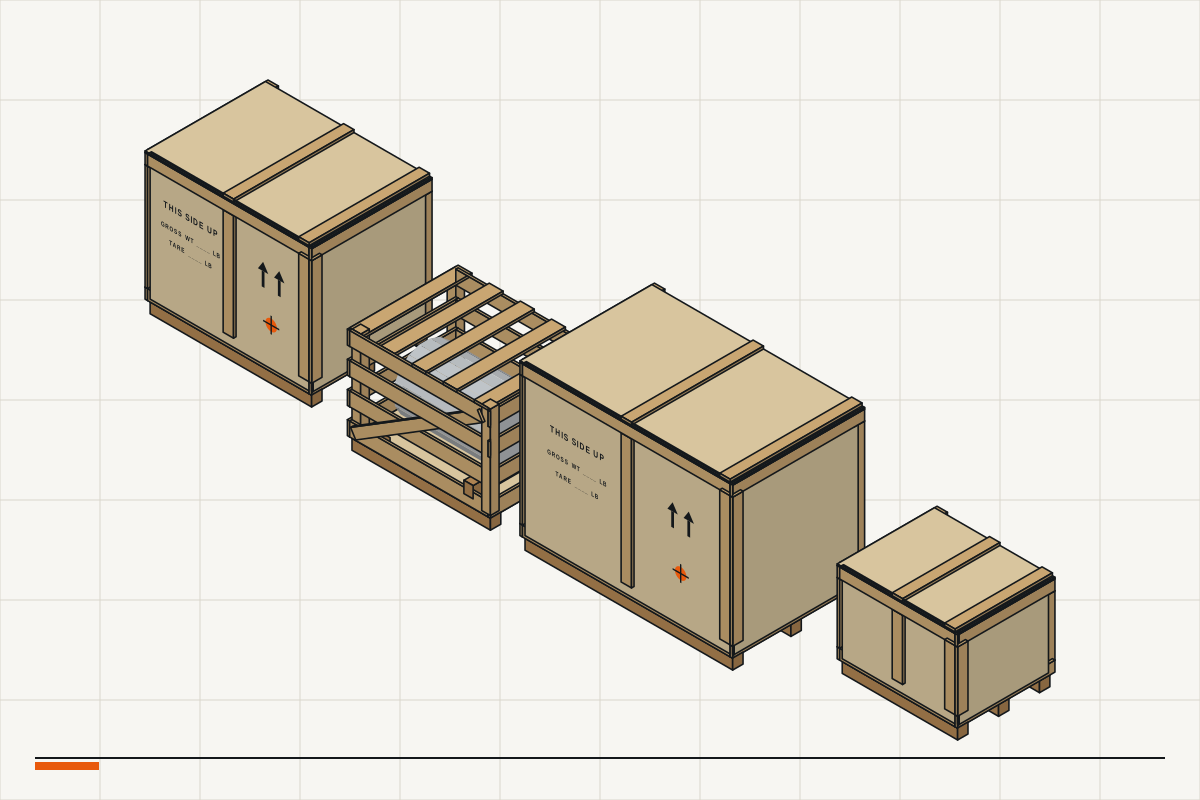
Crate spec ticket
| Load | Inside dimensions L x W x H in inches |
|---|---|
| Weight | Gross weight in pounds, with tare of any pallet |
| Destination | Country, and whether it moves by sea, air or road |
| Quantity | One crate, a run, or a standing release schedule |
| Date needed | Dock date at the shipper's site |
| Interior | Blocking, VCI, desiccant, tip indicators if wanted |
Crates: every page
| Page | What it is for | Quote |
|---|---|---|
| Custom wooden crates, built from your load | Best for: One-off, odd or high-value loads | Quote this |
| Industrial wooden crates for heavy loads | Best for: Machinery, castings, dense assemblies | Quote this |
| Standard wood crate sizes | Footprints: Often matched to pallet sizes | Quote this |
| Wooden crates in bulk, on a standing spec | Best for: 3PLs, kitting, repeat outbound | Quote this |
| Used and reconditioned wooden crates | Best for: Domestic moves, spares, returns | Quote this |
| Crate types | Constructions: Ten, each drawn on its own page | Quote this |
What we sell and who buys it
We are a national crating desk. Plant buyers, shipping managers, exporters, freight forwarders and 3PLs send us a load and we return a crate specification and a quote. The crate is built to order and delivered to the shipper's dock. We do not sell decor crates, planter boxes or craft stock; every crate on this site is a shipping container for freight.
Most requests arrive as a machine, a pallet of castings, a motor, a control cabinet or a batch of repeat parts. Each of those has different needs: some want open slats and a quick forklift pick, some want a sealed sheathed box with a VCI film liner inside, some only need a skid and a top frame. The programs below split the work along those lines.
Whatever the program, the quote begins from the same three numbers: the load's inside dimensions in inches, its gross weight in pounds, and the destination country. Add the quantity and the date you need the crate at your dock and we can write the spec down.
The five programs and when to pick each
Choose by the shape of the job, not by price alone. A one-off machine with an awkward centre of gravity belongs in a custom build. A heavy casting on a short haul may need only a heavier skid and a lid. A product that ships every week belongs on a standing spec. A returnable move between two plants may be a candidate for used crates.
The table gives the short version. Each program has its own page with the crate spec ticket we work from.
| Program | Pick it when | What we need |
|---|---|---|
| Custom | The load is one-off, odd-shaped, delicate or high value | Inside dimensions, gross weight, destination, handling points |
| Heavy-duty | Gross weight is high or the load bolts to its base | Gross weight, footprint, lifting and fork access needs |
| Standard sizes | The load fits a common footprint and repeats | Footprint, height, pallet size if palletised |
| Bulk | You ship the same crate on a schedule | Spec, quantity per release, delivery points |
| Used | The move is domestic, a spare, or a return | Inside dimensions, condition tolerance, destination |
Custom crates for loads that do not fit a template
A custom crate is drawn around the load. We take the inside dimensions, add clearance for blocking and bracing, and choose the skid, runners, cleats and sheathing to suit the gross weight. The finished spec lists every member, how it is fastened and what marks go on the outside.
This is the program for machine tools, instrument housings, fabricated assemblies, mould sets and anything that cannot take a hit on one corner. You can read the full method on the custom crates page.
Heavy-duty crates for machinery and dense loads
Once gross weight climbs, the base does most of the work. Heavy-duty crates use larger skid timbers and runners, lag bolts into the load's mounting points, strongbacks across the span and blocking cut to the machine's frame. Lifting points and fork pockets are planned in, not added later.
If you are shipping presses, generators, compressors or a skid-mounted package, start on the heavy-duty page. The weight you give us decides the base, so a scale ticket or nameplate figure helps.
Standard sizes and bulk orders for repeat freight
Some shippers do not need a new drawing each time. They ship the same part in the same crate every month. Standard sizes are common footprints, often built to match pallet dimensions such as 48 x 40 in, so the crate stacks and loads predictably. Bulk is the delivery arrangement that sits on top: one spec on file and releases against it.
We never promise stock on hand. Crates are built to the spec you approve, then released to your dock as agreed in the quote.
Used and reconditioned crates, with limits
Used crates cost less because they have already done a trip, and that is also the limit. Condition varies from one crate to the next. They suit domestic moves, spares, returns and internal plant transfers. They are a poor fit for export unless the wood still carries a valid IPPC mark, and any replaced boards need their own HT stamp under NELMA's rules. We state this on the quote rather than after.
Our used page explains what we inspect and what we will not promise.
Pick the construction before you pick the size
Underneath each program sits a construction: slatted, sheathed plywood, cleated plywood, skid-base, A-frame, knockdown, wirebound, long, solid lumber or returnable. The construction decides how the walls carry load, how air and moisture get in, and how the crate is opened at the other end.
The constructions hub draws all ten with a comparison table. If you already know you want, say, a knockdown crate that ships flat, name it on the quote and we will price that spec. If you do not, give us the load and we will recommend one.
Export, treatment and what we put on the crate
Wood packaging that leaves the country may need ISPM 15 treatment. Heat treatment under the US program means the wood core reaches at least 56 °C for at least 30 minutes, and the finished crate carries the IPPC mark. Plywood is exempt from the treatment requirement, which is one reason sheathed constructions are common in export work. Check the destination country's plant-protection authority for its rules, and read the export section for the detail.
Questions buyers ask
Which crate program should I start with?
Start with custom if the load is one-off, heavy-duty if gross weight is high, and bulk if you ship the same thing on a schedule. If you cannot decide, send inside dimensions, gross weight and destination and we will recommend one.
Do you keep crates in stock?
No. Crates are built to the approved spec and delivered to your dock. We do not claim stock on hand for any size.
Can one quote cover several crate types?
Yes. List each load with its inside dimensions and gross weight and we will spec each crate separately on one quote.
Are these crates for decor or storage?
No. We build industrial shipping crates only, not decor crates, planters or storage furniture.