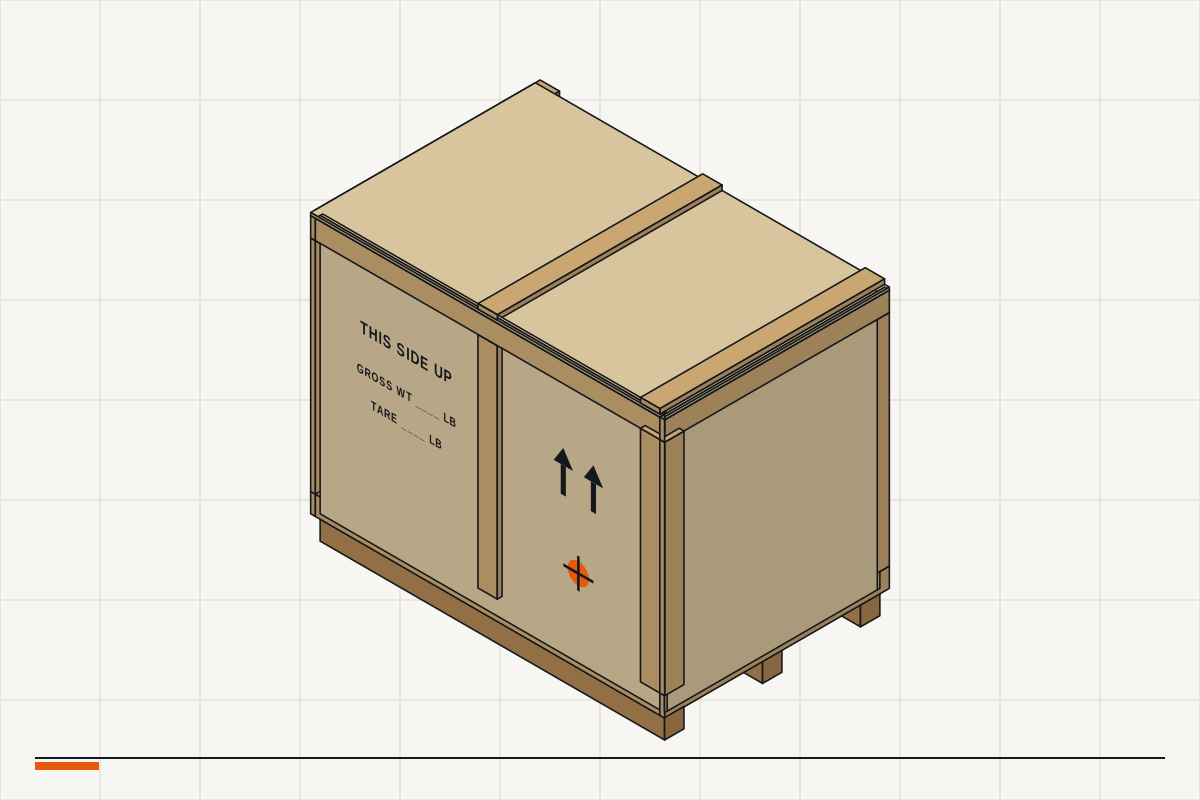
Crate spec ticket
| Gross weight | Pounds; decides skid and wall strength |
|---|---|
| Protection | Open air, weather-tight, or sealed with liner |
| Handling | Forklift, crane, hand or conveyor |
| Reuse | One-way, returnable or knockdown |
| Export | Solid wood needs HT and stamp; plywood is exempt |
| Shape | Compact, long, tall or flat |
Crate types: every page
| Page | What it is for | Quote |
|---|---|---|
| Slatted crates | Best for: Castings, forgings, dry parts | Quote this |
| Sheathed plywood crates | Best for: Machinery, controls, finished goods | Quote this |
| Cleated plywood boxes | Best for: Instruments, small equipment | Quote this |
| Skid-base crates | Best for: Heavy, dense machinery | Quote this |
| A-frame crates | Best for: Glass, stone, large panels | Quote this |
| Knockdown crates | Best for: Remote packing, repeat shipments | Quote this |
| Wirebound crates | Best for: Light loads, small parts, produce | Quote this |
| Long crates | Best for: Shafts, pipe, bar, extrusions | Quote this |
| Solid lumber crates | Best for: Rough handling, point loads | Quote this |
| Returnable crates | Best for: Closed-loop plant-to-plant runs | Quote this |
How construction differs from size
Size says how big the crate is. Construction says how it is made: which members carry the load, what the walls are, how the lid is held and how the crate is opened. Two crates with the same footprint can behave very differently on a truck depending on construction.
A slatted crate and a sheathed plywood crate may both measure 60 x 40 x 48 in on the inside, and one lets the weather in while the other keeps it out. A skid-base crate and a solid lumber crate may carry the same machine, and one weighs half as much. The right choice balances weight, protection and cost.
Below, each construction is introduced in a few lines, with a comparison table and a note on how to choose.
The ten constructions in brief
Slatted crates use spaced boards on a skid and frame. Sheathed plywood crates are framed boxes with plywood panels. Cleated plywood boxes are panels cleated at the edges without a heavy frame. Skid-base crates are a strong base with a top frame and bracing. A-frame crates have sloped sides for tall, flat items such as glass.
Knockdown crates ship flat and assemble on site. Wirebound crates fold up from thin wood bonded with wire. Long crates are built for bars, tubes and rails with extra stiffening along the length. Solid lumber crates use heavy boards throughout for the toughest loads. Returnable crates are built to be reused many times.
- Slatted: open walls, light, ventilated
- Sheathed plywood: closed, weather-tight, can be lined
- Cleated plywood: flat-faced box for light to medium loads
- Skid-base: heavy base, top frame, bracing
- A-frame: sloped sides for tall flat items
- Knockdown: ships flat, assembled on site
- Wirebound: folding, light, for compact goods
- Long: stiffened for bars, tube and rail
- Solid lumber: heaviest and roughest duty
- Returnable: designed for repeat trips
Comparison table
Use the table to narrow the field. It describes typical use, not a guarantee; the final spec is set by the load and the lane.
| Construction | Walls | Weight class | Weather protection | Reusable |
|---|---|---|---|---|
| Slatted | Open slats | Light to medium | Low | Sometimes |
| Sheathed plywood | Plywood panels | Light to heavy | High | Sometimes |
| Cleated plywood | Plywood, edge cleats | Light to medium | Medium to high | Limited |
| Skid-base | None or partial | Heavy | Low, unless covered | Sometimes |
| A-frame | Sloped panels | Light to medium | Medium | Often |
| Knockdown | Panels | Light to heavy | Medium to high | Yes |
| Wirebound | Thin wood, wire bonded | Light | Low to medium | Limited |
| Long | Open or closed, stiffened | Light to medium | Varies | Sometimes |
| Solid lumber | Heavy boards | Heavy | Medium | Sometimes |
| Returnable | Heavy, hinged or bolted | Medium to heavy | Medium to high | Yes, by design |
Choosing by weight
Gross weight narrows the list faster than anything else. For light loads, cleated plywood, wirebound and slatted crates are economical. For medium loads, sheathed plywood and knockdown crates become practical. For heavy loads, skid-base and solid lumber constructions carry the weight in the base and members, and sheathed versions add protection on top.
Tell us the weight in pounds, and whether it is measured or a catalogue figure. The base is sized from it.
Choosing by protection and environment
Ask what the crate must keep out. If the answer is dust and light rain, slatted and skid-base crates with a cover may be enough. If it is sea air, condensation or a week on a quay, a closed, lined crate with VCI and desiccant is the safer choice.
Also ask what the crate must keep in. Loose parts, thin sheet and fine finishes want closed walls. Large castings and forgings often do not.
Choosing by handling and reuse
If a forklift moves every crate, skid height and fork access come first. If a crane lifts, slings and lifting points come first. If a receiver must unpack by hand, a lid that opens cleanly matters.
Reuse changes the balance. A returnable or knockdown crate costs more at the start and may save on every trip after. A one-way crate is built to be opened once and discarded.
Mixing constructions inside one program
Real programs rarely use a single construction. A machine builder may send its main product in a skid-base crate, its control cabinet in a sheathed plywood box, its spare parts in cleated plywood boxes and its long guide rails in a stiffened long crate. Each is drawn from its own load, and all can sit on one quote.
There is a practical benefit. When every crate in a shipment shares a skid height and fork entry, a warehouse crew handles them the same way. We note that on the spec when it matters, and we match marks across the set so a receiver can tell which crate belongs with which machine.
If you are consolidating loads for a forwarder, tell us the container or trailer plan. Matching heights lets crates stack, and matching footprints leaves fewer gaps on the floor.
Export and the wood you choose
Solid wood members in export crates need ISPM 15 treatment and the IPPC stamp. APHIS describes heat treatment as bringing the wood core to at least 56 °C for at least 30 minutes. NELMA notes that plywood, particleboard, OSB, flakeboard and veneer are exempt, which is why many export crates are plywood-sheathed on a treated-lumber skid. Confirm the rules for the destination with its plant-protection authority.
Questions buyers ask
Which wooden crate type is the strongest?
Solid lumber and skid-base constructions carry the most weight, because the base and members do the work. The load's gross weight and handling decide which one is right.
Which crate type is best for sea freight?
A closed, sheathed plywood crate, lined and fitted with VCI and desiccant, is the usual choice for sea freight, because it keeps out moisture.
Which crate ships flat?
Knockdown crates ship flat and assemble on site. Wirebound crates also fold, for lighter loads.
Can you build a mix of types on one order?
Yes. List each load with its inside dimensions and gross weight and we will assign a construction to each.