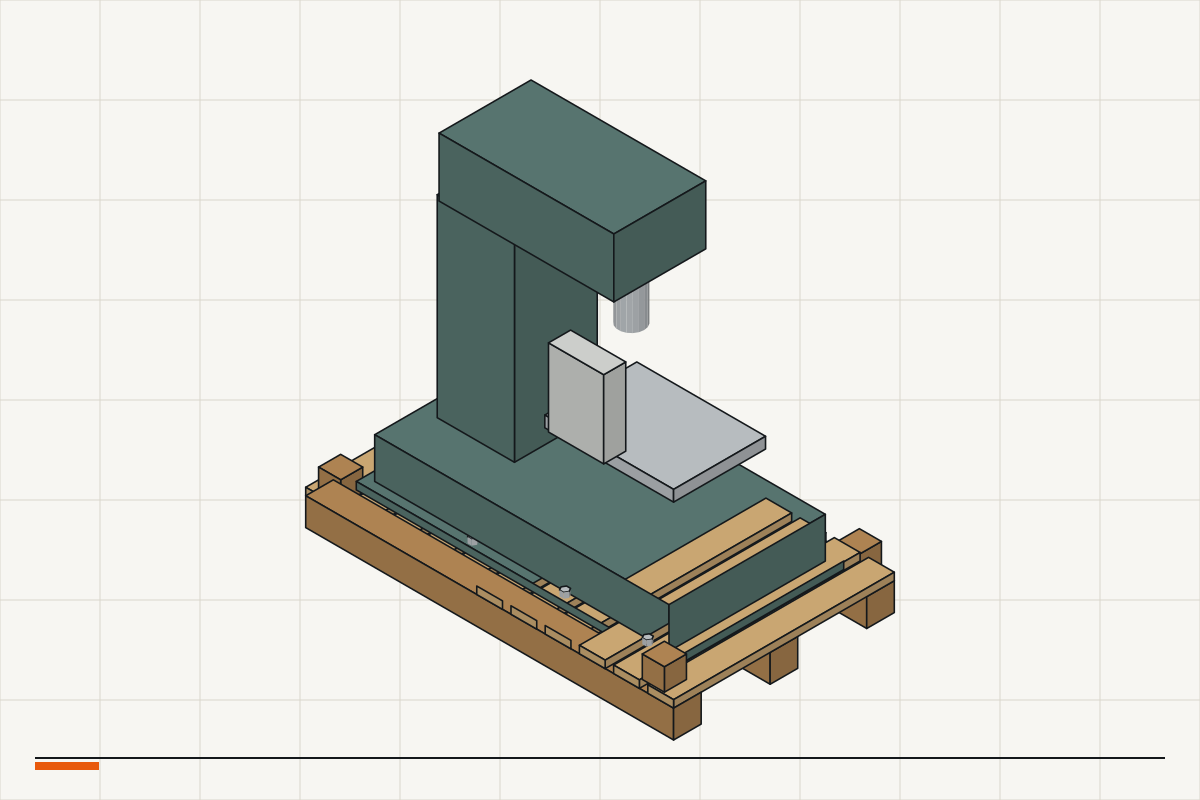
Crate spec ticket
| Step 1 | Tell us what the load is and send photographs |
|---|---|
| Step 2 | Give inside dimensions L x W x H in inches |
| Step 3 | Give gross weight in pounds |
| Step 4 | Name the destination country and route |
| Step 5 | Say how many crates and by when |
| We return | A written crate spec to approve |
What we crate: every page
| Page | What it is for | Quote |
|---|---|---|
| Machinery | Best for: CNC, presses, packaging lines | Quote this |
| Engines | Best for: Diesel, gasoline, gas engines | Quote this |
| Marine engines and outboards | Best for: Outboards, inboards, sterndrives | Quote this |
| Motorcycles | Best for: Road, touring and off-road bikes | Quote this |
| Paintings and framed art | Best for: Paintings, prints, framed works | Quote this |
| Sculpture | Best for: Bronze, stone, wood, steel works | Quote this |
| Server racks | Best for: Populated and empty racks | Quote this |
| Glass and glazing | Best for: Sheet glass, IGUs, windows | Quote this |
| Stone slabs | Best for: Granite, marble, quartz slabs | Quote this |
| Generators | Best crate: Skid-base, open or sheathed | Quote this |
| Transformers | Best crate: Skid-base with top frame | Quote this |
| Trade show exhibits | Best crate: Returnable, caster-mounted | Quote this |
| Pianos | Best crate: Sheathed, padded interior | Quote this |
| Pumps | Best crate: Skid-base, open or sheathed | Quote this |
| Control panels and switchgear | Best crate: Sheathed, tall and braced | Quote this |
| Molds and dies | Best crate: Skid-base, heavy bearers | Quote this |
| Castings and forgings | Best crate: Slatted, heavy skid | Quote this |
| Industrial robots | Best crate: Sheathed, padded interior | Quote this |
Every load has its own packing problem
A crate is only as good as the way it holds what is inside. A lathe wants lag bolts through its feet. An outboard wants a stand that copies the transom. A sheet of glass wants to stand on edge, and a painting wants to float in a box inside a box. The outside of a crate looks alike from one load to the next; the inside does not.
That is why we sort our work by what is being shipped. Each load page below starts from the load: how it is fixed down, what is drained or removed, where it is fragile, which construction fits, how moisture and shock are handled, and which handling marks go on. Start with the page nearest your cargo, then send us the numbers.
Eighteen loads against the construction that fits
The table gives the usual match. It is a starting point, because a heavy casting and a light casting can ask for different builds, and a long load may move to a long crate. Final choice comes after we have the inside dimensions and the gross weight.
| Load | Usual construction | What drives the build |
|---|---|---|
| Machinery | Skid-base | Bolt-down to the skid, VCI film, sling marks |
| Engines | Skid-base | Timber cradle, capped ports, drained fluids |
| Marine engines and outboards | Skid-base | Transom-style stand, salt corrosion, fuel rules |
| Motorcycles | Sheathed | Wheel chocks, strapped frame, fuel and battery rules |
| Paintings and framed art | Sheathed | Sealed inner travel frame, humidity buffer |
| Sculpture | Solid lumber | Shaped cradle, padded contact, strong lift points |
| Server racks | Sheathed | Shock isolators, ESD-safe wrap, tall footprint |
| Glass and glazing | A-frame | On-edge stacking, spacers, edge guards |
| Stone slabs | A-frame | Heavy runners, rubber ledge, slab spacers |
| Generators | Skid-base | Base-frame mounts, fuel drained, weather cover |
| Transformers | Skid-base | Tank lifting lugs, oil rules, bushing protection |
| Trade show exhibits | Sheathed | Reusable cases, foam cut-outs, repeat use |
| Pianos | Sheathed | Legs removed, soundboard climate, padded body |
| Pumps | Skid-base | Flanges capped, shaft locked, drained casings |
| Control panels and switchgear | Sheathed | Dust and moisture control, door locks |
| Molds and dies | Solid lumber | Dense loads, rust-preventive coating, block support |
| Castings and forgings | Solid lumber | Dunnage under rough faces, point-load spreading |
| Industrial robots | Skid-base | Arm locked in transport pose, controller crated |
How the constructions differ
A skid-base crate is a strong base with framed walls on top, and it is the default for anything heavy that must be bolted down. A sheathed crate has plywood skin on framing and suits light to mid-weight goods that need a closed, clean box. A solid-lumber crate is boards on a frame, built for dense loads. An A-frame is a skid with a leaning rack for flat goods.
The detail sits on our crate-type pages. We link the matching one from each load, so a buyer can compare how the members are put together, and what each build does to the tare weight and cube of the shipment.
What stays the same on every crate
Some things do not change with the load. Every crate has a skid sized to the gross weight, forklift entry on the right sides, a lid that can be opened for inspection, and ISO 780 marks on the outside. Every crate is drawn on a written spec before it is built.
A moisture plan goes in every crate bound for sea or a long road trip: VCI where bare metal is present, a barrier bag where the load cannot take condensation, and desiccant sized to the volume. Tip and shock indicators are fitted when the buyer wants proof of how the crate was handled.
Cargo with its own rules
Some loads fall under hazardous-materials rules. Engines, motorcycles, generators and anything with fuel or a battery are regulated under 49 CFR for ground and sea, and under the IATA rules for air cargo, so fluids are drained and batteries disconnected according to the carrier's requirements. Transformers carry insulating oil, and the carrier's rules on oil govern the packing.
Other cargo has a standard way of travelling. Artwork wants a climate-buffered inner box. Glass and stone must stand on edge. Pianos need their legs and pedals removed, and electronics need static control. Each load page states the rule for that cargo in general terms; the carrier and the consignee have the last word.
Export, ISPM 15 and wood
Wood used in an export crate must meet the destination country's rules on wood packaging. ISPM 15 requires treatment, usually heat treatment, and the IPPC stamp. Plywood is exempt. Check USDA APHIS and the importing country's plant-protection authority, and send us the destination so we can state the right lumber on the spec.
For a repeat shipper, the crate spec stays on file. The second order is built the same way as the first, which makes packing lists and customs paperwork consistent from one shipment to the next.
How to get a crate quote for your load
A quote needs three numbers: the load's inside dimensions L x W x H in inches, its gross weight in pounds, and the destination country. Add the quantity and the date you need the crate. Photographs of the load, the mounting points and the nameplate speed things up.
Use the form on this page, or write to info@shippingcratesforsale.com and attach the photographs. If your cargo is not on the list, send it anyway: the list is a map of the common cases, not a limit. Our guide to crating machinery goes through the bolt-down, wrap and mark steps in order.
Questions buyers ask
What if my load is not on the list?
Send photographs and the three numbers anyway. The eighteen loads are the common cases, and an unlisted load is matched to the nearest construction.
Do you crate used and reconditioned equipment?
Yes. Equipment age does not change the crate, but missing mounts or leaking fluids do, so tell us the condition.
Which loads have hazardous-materials rules?
Anything with fuel or a battery, such as engines, motorcycles and generators, plus oil-filled equipment. Carriers set the drain and disconnect requirements.
Can one crate hold two loads?
Sometimes, with partitions and separate hold-downs. We check the combined gross weight and the centre of gravity first.