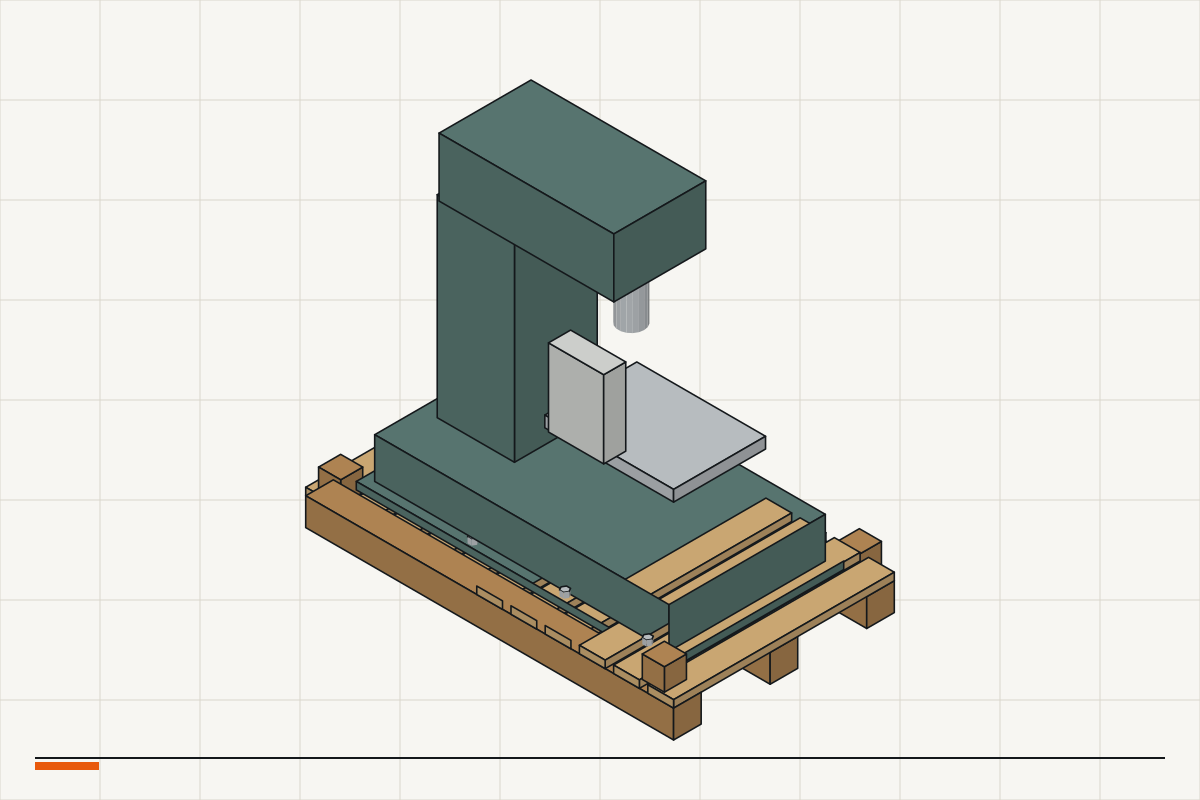
Crate spec ticket
| Gross weight | Pounds, from a scale ticket or nameplate; says whether it is measured |
|---|---|
| Footprint | Length x width of the contact area in inches |
| Height | Overall height in inches, with any removable parts off |
| Mounting | Bolt holes or feet the load is secured through |
| Lifting | Forklift access from which sides; crane eyes if fitted |
| Centre of gravity | Position, or a note that the load is top-heavy |
| Interior | Blocking, VCI, desiccant, rust inhibitor on bare steel |
What makes a crate heavy-duty
A heavy-duty crate is defined by what its base has to carry. Once the load is dense, the crate is a pallet with walls on it, and the walls matter less than the timbers underneath. The skid has to resist bending between forks. The runners have to spread point loads. Fasteners have to hold when the crate is lifted by the corner.
The heavy-duty program covers machine tools, presses, compressors, pumps, motors, castings, dies and skid-mounted packages. It is also the program we use when a load is small but unusually dense, such as a block of tool steel or a gearbox.
We specify these crates by gross weight first and dimensions second. That is the reverse of how most buyers think about a box, and it is deliberate.
Sizing the skid and runners to gross weight
The skid is the pair or set of timbers the crate stands on. Its section and species are chosen for the load, and so is its spacing. Wider spacing makes it easier to get forks in; narrower spacing supports a small footprint better. Runners, laid across or under the skid, tie the structure together and take the shear.
Gross weight includes everything: the machine, its tooling, any fluids, bolt-on guards, pallet and blocking. Tare, the weight of the empty crate itself, adds to what a forklift or a floor must carry, so we include it in your freight figures too.
If you are unsure of the weight, say so. A casting weighed on a scale is reliable. A catalogue figure for a machine with options fitted is not.
- Skid timber section chosen for the span between forks
- Runners or cross-members tied to the skid with fasteners rated for the load
- Extra skid length where the load overhangs the footprint
- Weight noted on the exterior with the centre-of-gravity mark
Bolt-down, strongbacks and blocking
A heavy load that can slide will break its crate. We anchor it to the base with lag bolts through the machine's own mounting feet or holes wherever that is possible. If there are no mounting points, we frame the load in with blocking and bracing cut to its profile.
A strongback is a stiff beam laid across the top of the frame or along the length of a long load. It stops the lid and uprights from racking and lets the crate carry a second tier, if the spec allows. We add one where the span is long or the load is top-heavy.
Lag bolts should be torqued with the load level. We note the bolt size and location on the spec so the receiving plant can undo them in the same order.
Lifting, fork access and crane points
Plan the lift before you build. If the crate will be handled by forklift, forks need clear entry from the sides you name, and the skid needs enough clearance underneath for them. If it will be lifted by crane or sling, we leave the sling points free and mark them.
Tell us how the crate is picked up at origin, at any transfer, and at the receiving dock. A crate that suits your forklift may not suit the port crane at the other end. A top-heavy load may need a tip indicator and an instruction on the outside.
These details cost almost nothing on the drawing and a great deal after the crate arrives wrong.
Open base or closed crate
Not every heavy load needs walls. A skid-base crate is a heavy base, a top frame and bracing, and nothing in between. It is quick to load, easy to inspect and light on lumber. For loads that need weather protection, we add sheathing in plywood on the frame, and a liner if rust is a risk.
The comparison page for skid-base crates draws the frame. For machinery moves, the machinery guide covers the decision in more detail, from draining fluids to covering exposed slides and ways.
Export, treatment and corrosion control
A heavy crate going overseas typically needs heat-treated lumber with the IPPC stamp. Under APHIS, heat treatment means the wood core reaching at least 56 °C for at least 30 minutes. Plywood is exempt, but skids and timbers are solid wood, so they are not.
Bare ferrous surfaces rust fast in a container. We list the protection on the spec: a rust inhibitor applied by you, VCI film or paper around the load, and desiccant in a sealed crate. Say if the destination is humid or the transit long.
Questions buyers ask
How heavy a load can your crates carry?
The base is sized to the gross weight you give us, so there is no fixed ceiling on the page. Send the weight in pounds and the footprint and we will spec the skid and runners.
Do you bolt the machine to the crate?
Yes, where the machine has mounting feet or holes. We use lag bolts into the base and note them on the spec. Where it has none, we block and brace it.
Can the crate be lifted by crane?
Yes. Tell us the sling or crane points and we leave them clear and marked on the exterior.
Is a heavy-duty crate always closed?
No. Many are open skid-base frames. We add sheathing and a liner only when the load needs weather or corrosion protection.